Ever wonder how much of your hard-earned money you’re truly saving? 🤔 Understanding your savings rate is a super important step towards achieving financial freedom and reaching your dreams, whether it’s buying a home, planning for retirement, or just building a safety net.
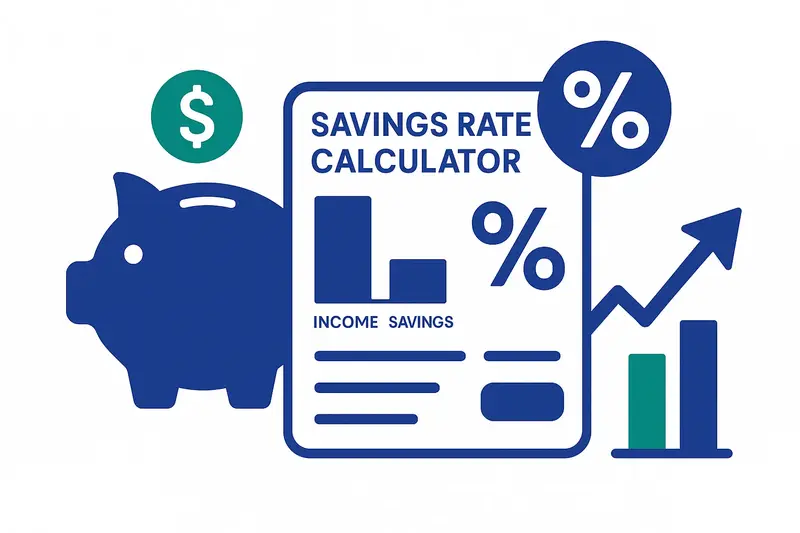
Our Savings Rate Calculator is designed to give you a clear picture of your saving habits. It helps you quickly see what percentage of your income you’re setting aside each month. Think of it as your personal financial report card for savings! Ready to see how you’re doing? Let’s dive in!
Savings Rate Calculator
This calculator determines the percentage of income you are saving. Understand your savings habits and track your progress towards financial goals!
Your Savings Rate:
How to Use Your Savings Rate Calculator: Simple Steps!
Using the Savings Rate Calculator is a breeze! Just follow these easy steps:
Step 1: Find the Calculator
Look for the Savings Rate Calculator right here on our page. You can’t miss it!
Step 2: Enter Your Total Monthly Income 💰
In the first box, labeled “Total Monthly Income ($)”, type in your total income for one month after taxes. This includes your regular paycheck, any side hustle earnings, rental income, etc.
Tip: Be accurate! The more precise you are, the more helpful your results will be. For example, if you bring home $4,000 every month, just type “4000”.
Step 3: Enter Your Total Monthly Savings 🏦
Next, in the “Total Monthly Savings ($)” box, enter the total amount of money you save in an average month. This includes money put into:
Your emergency fund
Retirement accounts (401k, IRA)
Investment accounts
Savings accounts for specific goals (down payment, vacation)
Any extra payments you make on debt (like mortgage principal or student loans, if you count them as savings for future financial gain).
Example: If you save $600 a month consistently, enter “600”.
Step 4: Calculate Your Rate! ✨
Once both fields are filled, simply click the “Calculate Savings Rate” button.
Understanding Your Results & Taking Action! 📈
After you click ‘Calculate’, our Savings Rate Calculator will instantly show you your personal savings rate as a percentage. But it doesn’t stop there! You’ll also get a friendly, dynamic message tailored to your results.
“Fantastic!” 🥳 If you see this, you’re doing an amazing job! It means you’re saving a significant portion of your income and are likely well on your way to your financial goals.
“Good progress!” 👍 This means you’re on the right track! You’ve got solid saving habits, and with a little more effort, you can accelerate your progress.
“Let’s boost those savings!” 🤏 Don’t worry if you see this. It just means there’s room for improvement. The good news is, even small increases in your savings can make a big difference over time!
Use this information to:
Set Goals: If your rate is lower than you’d like, set a new goal! Even increasing it by 1-2% next month is a win.
Adjust Spending: See where you can cut back. Small daily expenses add up!
Find More Income: Can you pick up a side gig or negotiate a raise? More income often means more savings potential.
Celebrate Wins! When your savings rate improves, acknowledge your hard work!
Frequently Asked Questions (FAQ)
What is a "good" savings rate?
Many financial experts recommend aiming for a savings rate of at least 15% to 20% of your gross income. However, what’s “good” depends on your individual financial goals and timeline. The higher, the better for long-term wealth!
Should I include taxes in my "Total Monthly Income"?
For this Savings Rate Calculator, it’s generally best to use your net income (what you actually receive after taxes and deductions). This gives you a more realistic picture of the money you have available to save.
What if my income changes each month?
If your income varies, use an average monthly income over the last 3-6 months. This will give you a more accurate overall picture.
Does paying off debt count as "savings"?
It depends on the debt! Paying off high-interest consumer debt (like credit cards) is often considered reducing liabilities rather than building assets. However, aggressively paying down a mortgage or student loan can be viewed as “forced savings” because you’re building equity or reducing future interest payments. For this Savings Rate Calculator, it’s typically focused on money going into liquid savings or investment accounts.
Why did I get an "N/A" result or an error message?
This usually happens if you enter zero for income but a positive amount for savings, or if your savings amount is higher than your income. The calculator needs logical inputs to provide a valid rate. Double-check your numbers and try again!
Start Saving Smarter Today! ✨
We hope our Savings Rate Calculator empowers you to take control of your financial future! Remember, every little bit you save adds up. Keep tracking your progress, making smart money moves, and don’t hesitate to use our other helpful tools on the website. Happy saving! 💰😊
Learn More: Smart Savings Strategies for Beginners